
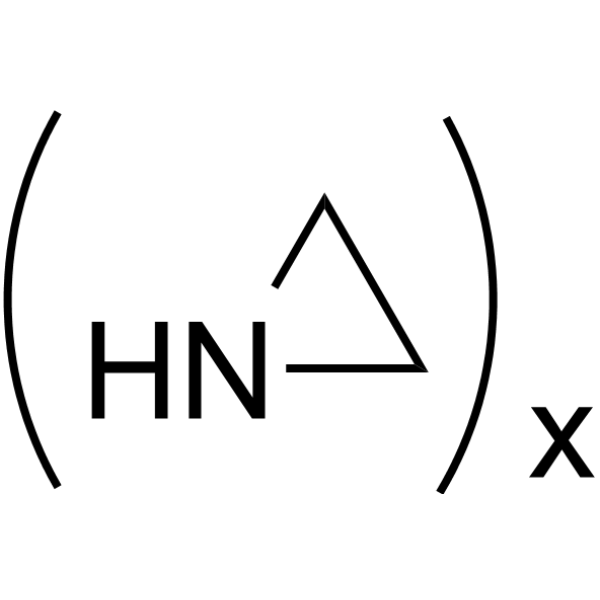
Executive Summary
Heavy metal contamination remains one of the most critical environmental challenges faced by modern industries. Sectors including electroplating, printed circuit board (PCB) manufacturing, mining, battery recycling, semiconductor fabrication, photovoltaic production, and metal finishing generate wastewater containing toxic metal ions such as Hg2+, Cu2+, Pb2+, Cd2+, Ni2+, Co2+, Zn2+, Cr3+, Ag+ and others.
Conventional precipitation technologies—including hydroxide precipitation, sulfide precipitation, sodium dimethyldithiocarbamate (Na-DDTC), trimercapto-s-triazine (TMT), and xanthates—have been widely adopted for decades. While effective under certain operating conditions, these technologies increasingly face significant limitations:
- Incomplete removal of trace heavy metals
- Narrow operating pH window
- Poor selectivity in complex wastewater matrices
- High sludge production
- Slow solid-liquid separation
- Limited metal recovery potential
- High overall operating cost
To address these challenges, Polyethyleneimine Dithiocarbamate (PEI-DTC) has emerged as a next-generation polymeric heavy metal collector that integrates polymer chemistry, chelation science, and flocculation technology into a single multifunctional material.
Unlike conventional low-molecular-weight DTC collectors, PEI-DTC contains hundreds to thousands of dithiocarbamate functional groups distributed along a polyethyleneimine backbone, creating an exceptionally high density of metal-binding sites. This unique architecture enables simultaneous electrostatic attraction, multidentate chelation, polymer bridging, and rapid floc formation.
The result is a collector that offers:
- Superior heavy metal removal efficiency
- Broad pH applicability
- Rapid settling
- Lower sludge volume
- Improved selectivity
- Potential for metal recovery
- Reduced total treatment cost
This white paper presents the chemistry, mechanism, performance characteristics, industrial applications, and commercial value of PEI-DTC while comparing it with conventional DTC collectors and competing precipitation technologies.
Chapter 1 — Global Challenges in Heavy Metal Wastewater Treatment
1.1 Industrial Background
Industrialization has dramatically increased the discharge of heavy-metal-containing wastewater worldwide.
Major sources include:
- Electroplating
- Mining
- Smelting
- Battery manufacturing
- Lithium-ion battery recycling
- PCB manufacturing
- Semiconductor fabrication
- Solar photovoltaic manufacturing
- Chemical production
- Metal finishing
The concentration of heavy metals may vary from a few parts per billion (ppb) to several grams per liter depending on the industrial process.
Increasingly stringent environmental regulations require industries to reduce metal concentrations to extremely low discharge limits.
1.2 Challenges of Conventional Technologies
Hydroxide precipitation remains the most widely used process due to its simplicity. However:
- High sludge production
- Poor selectivity
- Amphoteric metals re-dissolve
- Difficult sludge dewatering
Sulfide precipitation offers stronger metal affinity but introduces issues such as:
- Hydrogen sulfide generation
- Odor
- Safety concerns
- Sulfide oxidation
Small-molecule DTC collectors improve selectivity but still suffer from:
- Limited chelation capacity
- Slow sedimentation
- Fine particle formation
- Sensitivity to competing ions
These limitations motivate the development of advanced polymeric collectors.
1.3 Market Trends
The global wastewater treatment market is shifting toward:
- Resource recovery
- Circular economy
- Lower carbon footprint
- Lower sludge generation
- Smart chemicals
- Sustainable treatment technologies
Polymeric collectors are becoming increasingly attractive because they combine multiple treatment mechanisms into one reagent.
Chapter 2 — Evolution of Dithiocarbamate Collectors
First Generation — Simple Alkyl DTCs
Examples:
- Sodium Dimethyldithiocarbamate (Na-DDTC)
- Sodium Diethyldithiocarbamate (Na-DEDTC)
- Sodium Dibutyldithiocarbamate
Characteristics:
- Single active site
- Fast reaction
- Low molecular weight
- Limited capacity
Second Generation — Aromatic DTCs
Advantages:
- Higher stability
- Better selectivity
Disadvantages:
- Higher synthesis cost
- Lower biodegradability
Third Generation — Polymer-Grafted DTCs
Including:
- PAM-DTC
- PVA-DTC
- Chitosan-DTC
- Starch-DTC
Advantages:
- Higher molecular weight
- Better flocculation
Limitations:
- Limited functional density
- Backbone chemistry restricts optimization
Fourth Generation — PEI-DTC
PEI-DTC represents a significant advancement by combining:
- Highly branched polymer architecture
- Extremely high amine density
- Adjustable molecular weight
- Controllable substitution degree
- Excellent water solubility
- Strong electrostatic interaction
- High chelation density
The polyethyleneimine backbone provides an ideal platform for introducing hundreds or thousands of dithiocarbamate groups.
This architecture dramatically increases metal-binding capacity while simultaneously improving flocculation performance.
Chapter 3 — Molecular Design of PEI-DTC
The unique performance of PEI-DTC originates from its molecular architecture.
Unlike traditional DTC molecules containing only one chelating site, PEI-DTC possesses numerous chelating groups distributed along a flexible polymer chain.
Conceptually:
      DTC
       |
DTC—PEI Backbone—DTC
       |
      DTC
       |
      DTC
Each polymer molecule behaves as a multifunctional metal collector capable of binding numerous metal ions simultaneously.
This creates several advantages:
- Multiple coordination sites
- High local ligand density
- Polymer bridging
- Stronger floc formation
- Faster sedimentation
3.1 Adjustable Molecular Weight
Commercial PEI can be synthesized over a broad molecular-weight range, typically from several hundred to tens of thousands of Daltons.
This enables product customization for different applications.
| Product Grade | Typical Application |
|---|---|
| PEI-DTC 600 | Rapid reaction, low viscosity |
| PEI-DTC 1800 | General wastewater treatment |
| PEI-DTC 10000 | High-capacity industrial systems |
| Branched PEI-DTC | High flocculation efficiency |
| Linear PEI-DTC | High diffusion efficiency |
3.2 High Density of Active Sites
One PEI molecule may contain hundreds of reactive amino groups.
After dithiocarbamylation:
- Primary amines become DTC ligands
- Secondary amines remain available for electrostatic interactions
- Tertiary amines contribute to charge regulation
This multifunctionality allows PEI-DTC to combine adsorption, chelation, and coagulation in a single material.
Document version: Technical White Paper v1.0 · Prepared for industrial partners, engineering companies, environmental consultants and investors.
Chapter 4 — Synthesis Chemistry of PEI-DTC
The synthesis of Polyethyleneimine Dithiocarbamate (PEI-DTC) is a controlled nucleophilic addition reaction wherein the highly reactive amine groups of the polyethyleneimine (PEI) backbone are grafted with dithiocarbamate functional groups.
4.1 Reaction Pathway
The synthesis typically occurs in an aqueous alkaline medium. Carbon disulfide (CS2) is introduced to the PEI solution in the presence of a strong base, typically sodium hydroxide (NaOH) or potassium hydroxide (KOH).
PEI possesses a highly branched structure comprising primary, secondary, and tertiary amines. The primary and secondary amines actively participate in the dithiocarbamylation process, while tertiary amines remain unreacted, contributing to the polymer's overall cationic charge and solubility.
Reaction for Primary Amines:
R–NH2 + CS2 + NaOH ⟶ R–NH–CS2Na + H2O
Reaction for Secondary Amines:
R1–NH–R2 + CS2 + NaOH ⟶ R1–N(CS2Na)–R2 + H2O
4.2 Substitution Degree and Product Design
A critical parameter in PEI-DTC synthesis is the Degree of Substitution (DS), which represents the percentage of available amine groups converted into DTC groups.
- Low DS (10%–20%): Yields a highly cationic polymer with moderate chelation, ideal for wastewater with high levels of suspended solids where aggressive electrostatic coagulation is required alongside metal removal.
- High DS (30%–50%+): Maximizes the density of heavy metal binding sites. This is optimized for industrial streams with high concentrations of dissolved heavy metals, ensuring maximum chelating capacity (often exceeding 300 mg of metal per gram of polymer).
By manipulating the molecular weight of the raw PEI (e.g., 600 Da up to 70,000 Da) and the DS, the resulting PEI-DTC can be precisely engineered for specific industrial environments.
Chapter 5 — Chelation Mechanism
The primary mechanism for heavy metal removal by PEI-DTC is multidentate chelation. This interaction is best understood through the framework of the Pearson Hard-Soft Acid-Base (HSAB) theory.
5.1 The HSAB Principle in Action
Heavy metal ions such as Hg2+, Ag+, Cu2+, Pb2+, Cd2+, and Zn2+ act as "soft" Lewis acids. The sulfur atoms in the dithiocarbamate group (–CS2−) act as "soft" Lewis bases. According to HSAB theory, soft acids form exceptionally stable, highly covalent complexes with soft bases.
5.2 Coordination Chemistry
Each DTC group acts as a bidentate ligand, meaning both sulfur atoms donate electron pairs to a single central metal ion, forming a highly stable four-membered chelate ring.
For a typical divalent heavy metal (M2+), the localized complexation with the polymer's active sites can be represented as:
2 R–NC−S2 + M2+ ⟶ [M(S2CNR)2]
Because PEI-DTC contains hundreds of these –CS2− groups along a single polymer chain, it does not rely on a 1:1 molecular interaction. Instead, a single PEI-DTC macromolecule wraps around and securely binds multiple metal ions simultaneously, forming an irreversible macromolecular metal complex that forces the metals out of their dissolved phase.
Chapter 6 — Adsorption, Bridging and Flocculation Mechanism
Conventional heavy metal precipitants typically require a multi-step process: chemical precipitation, followed by the addition of a coagulant (like PAC), and finally a flocculant (like PAM). PEI-DTC consolidates these steps into a single continuous mechanism.
Phase 1: Electrostatic Adsorption (Coagulation)
Despite the addition of anionic DTC groups, the unreacted amines (particularly tertiary amines) on the PEI backbone ensure the polymer retains a net positive charge in neutral to mildly acidic water. When introduced to wastewater, the cationic PEI-DTC instantly neutralizes the negative surface charges of colloidal particles and anionic metal complexes, destabilizing the suspension.
Phase 2: High-Density Chelation
Simultaneously, the grafted DTC groups seek out and coordinate with dissolved heavy metal ions. Due to the high local concentration of ligands on the polymer chain, the reaction kinetics are incredibly fast, stripping metals from weaker competing ligands (such as EDTA or ammonia) often present in plating wastewater.
Phase 3: Polymer Bridging (Flocculation)
As the PEI-DTC chain binds metal ions, it undergoes a conformational change, transitioning from a highly soluble state to a hydrophobic, insoluble state. The exceptionally long polymer chains act as structural bridges, sweeping through the water and tying thousands of microscopic metal-DTC complexes together.
This results in the immediate formation of massive, dense, and structurally sound flocs that settle rapidly under gravity, leaving highly clarified supernatant.
Chapter 7 — Why PEI-DTC Outperforms Conventional DTC Collectors
While small-molecule DTCs (like Na-DDTC) share the same active functional group, their performance is fundamentally limited by their architecture.
- Capacity Overkill: A small-molecule DTC binds metals at a strict stoichiometric ratio (e.g., 2 molecules of Na-DDTC for 1 Cu2+ ion). PEI-DTC's polymeric structure allows one molecule to capture hundreds of metal ions, drastically reducing the required chemical dosage.
- Floc Morphology: Small-molecule DTCs generate microscopic, powdery precipitates that remain suspended and are notoriously difficult to filter. PEI-DTC generates macroscopic, heavy flocs that self-settle in minutes, entirely eliminating the need for secondary coagulants.
- Resistance to Competing Ions: In complex matrices (like PCB manufacturing effluent containing high sodium or calcium salts), small-molecule DTCs lose efficacy. The macro-structure of PEI-DTC provides a localized binding environment that shields the active sites from alkaline-earth metal interference, maintaining extreme selectivity for heavy metals.
Chapter 8 — Comparative Performance Against Commercial Technologies
The following table benchmarks PEI-DTC against the industry's most common alternative precipitation chemistries.
| Parameter | Hydroxide (NaOH / Lime) | Sulfide (Na2S) | TMT-15 | Small-Molecule DTC | PEI-DTC (Polymeric) |
|---|---|---|---|---|---|
| Removal Efficiency | Low (limits at ~1–5 ppm) | High | Moderate–High | High | Extremely High (< 0.1 ppm) |
| Selectivity | Very Poor | Poor | Moderate | Good | Excellent |
| pH Operating Window | Narrow (highly specific per metal) | Broad | Broad | Moderate (pH 6–10) | Very Broad (pH 3–11) |
| Reaction Kinetics | Moderate | Fast | Moderate | Fast | Instantaneous |
| Floc Size & Settling | Poor to Moderate | Very Poor (colloidal) | Moderate | Poor (fine particles) | Excellent (massive flocs) |
| Sludge Volume | Extremely High | High | Moderate | Moderate | Minimal (highly compact) |
| Toxic Gas Risk | None | High Risk (H2S) | None | Low (potential CS2) | None |
| Complexed Metals | Cannot break EDTA / Ammonia | Moderate capability | Good capability | Good capability | Excellent (strips complexed metals) |